

How to Prepare for Your Treatment
To ensure the success of your laser hair removal, it is necessary to follow a few tips on how to prepare for the treatment, as well as how to care for your skin afterward. The goal of preparation is to ensure the hair root is present and the skin is as less sensitive as possible.

Before the treatment
- Stop pulling hair out: At least 4 weeks before the treatment. The hair root must be in the follicle for the laser to be able to destroy it.
- Shawing: The day before your treatment, shave the area to be treated with a razor. On the day of your appointment, your skin must be completely clean do not apply any creams, deodorants, or perfumes...
- Defining tanned skin: Our 4D TEC laser uses technology that is safe for various skin types, including darker and tanned complexions; however, it is advised to avoid sun exposure and tanning beds for at least 5 days before the treatment. If the skin is red, inflamed, or peeling after sunbathing, a break of 7–14 days is required until the skin has fully recovered. During the summer period, it is mandatory to apply SPF 50 for 5–7 days before the treatment on the areas you wish to treat.
- No self-tanning products: For at least two weeks before the treatment, you must not use self-tanning creams, sprays, or foams. These products block the path of light to the hair root.
- Facial Tips: 3–5 days before and after the treatment, stop using retinol (vitamin A), vitamin C, as well as AHA/BHA acids (glycolic, salicylic). These ingredients make the skin extremely sensitive to light and heat. Do not apply any makeup to your face on the day of the treatment.
- Which medications are prohibited: Certain medications cause photosensitivity (increased skin sensitivity to light). Retinoids – a strict contraindication; a 6-month break must be taken after finishing the therapy. Antibiotics – tetracycline, doxycycline, and certain other antibiotics are photosensitive, so a 7–10 day break is mandatory after the last dose. St. John's Wort (in the form of tea or oil) is known for causing photosensitivity. Painkillers – can increase sensitivity if taken immediately before the treatment.
Aftercare
- Avoid heat: For the first 24 hours, avoid hot water, saunas, Turkish baths, and intense workouts that cause heavy sweating.
- No chemicals: Do not apply perfumes, deodorants (if the armpits were treated), or strong scented lotions to the treated area.
- Skin hydration: After the treatment, you can use panthenol cream or pure aloe vera gel to provide extra hydration to your skin.
- No physical activities: Avoid intense workouts that cause heavy sweating for up to 48 hours after the treatment.
- Facial Tips: For 5 days after the treatment, stop using retinol (vitamin A), vitamin C, as well as AHA/BHA acids (glycolic, salicylic); also, avoid harsh mechanical peels.
- Do not pull out hairs: If hair appears before your next scheduled appointment, you may remove it exclusively with a razor. Pulling out hair with tweezers, wax, or sugar paste is strictly forbidden. The laser needs the hair root to be present so it can "target" it again during the next treatment.
- Natural process: Treated hairs will begin to fall out on their own within 10 to 14 days after the treatment. Don't worry, this is not new growth; it is simply your skin shedding the destroyed follicles.
Frequently Asked Questions
Is the treatment painful?
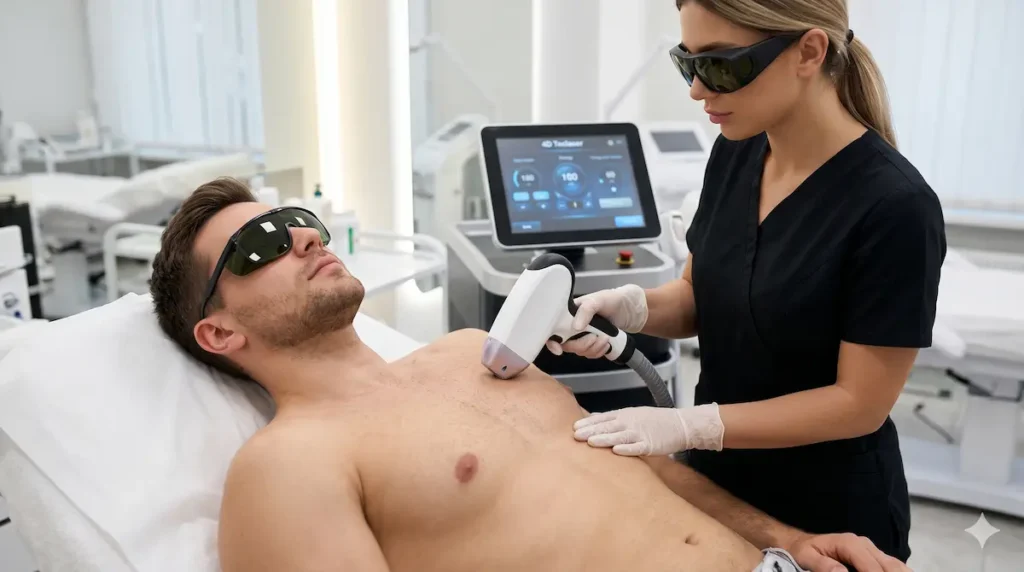
Thanks to the advanced cooling system of our 4D Teclaser, the treatment is virtually painless. The sensation is described as a slight tingling or cooling, which is significantly more comfortable compared to older generations of lasers.
How many treatments do I need?
To achieve permanent results, an average of 6 to 8 treatments is required. This is because the laser only affects hairs that are in the active growth phase, and they do not all grow at the same time.
What is the interval between treatments?
Treatments are performed at intervals of 4 to 6 weeks for the body, while for the face, they are done every 4 weeks. It is important to adhere to this plan so that we can “catch” every hair in the correct phase.
Can I sunbathe between treatments?
We recommend taking a break from direct sun exposure and tanning beds 7 days before and 7 days after the treatment. On exposed areas, the use of sunscreen with a high protection factor (SPF 50) is mandatory.
Does the laser work on light hairs?
Our 4D Teclaser works on the principle of selective photothermolysis. This means the laser beam exclusively targets melanin (the dark pigment) in the hair. The laser beam travels through the hair to the very root (follicle), where light energy is converted into heat, permanently destroying the root and preventing regrowth.
Dark and brown hair: These contain the most melanin, and the laser works perfectly on them. The darker and thicker the hair, the faster the results.
Light brown hair: Our laser is one of the few that is highly successful even with lighter shades of brown, as it utilizes four different wavelengths that penetrate deeper.
Blonde, red, and gray hair: Unfortunately, very light (nearly white), bright red, or gray hairs lack sufficient pigment. Since the laser “searches” for color to know where to strike, it simply cannot see these hairs.
If the hair is completely devoid of pigment (white or transparent), no medical laser in the world can permanently remove it. Fortunately, most clients have “mixed” hair types; even if they are lighter, the laser can often significantly thin them out and slow down their growth.